Route overview
This is a short rental car for foreigners in China loop starting in Taizhou: three days through Linhai old town, the Shenxianju peaks and the old river port of Batan, about 300 km in total, mostly expressway plus gentle mountain roads. It suits first-time visitors to eastern Zhejiang who want old canal towns and dramatic rock peaks, and families travelling with children or older parents. A rental car for foreigners in China picked up in Taizhou keeps the paperwork simple, and the mountain sections are curvy but never steep.
Highlights
- Linhai's old city wall and Ziyang Street, where one street covers all the eastern Zhejiang snacks
- The Ruyi Bridge and South Gate of Shenxianju, at their best when cloud seas roll through
- Batan's cobbled main street, quiet and almost empty of tour groups
- Ample car parks at the scenic areas, so a rental car for foreigners in China works well here
Suggested itinerary
- Day 1Day 1 Taizhou pick-up, Linhai city wall, Ziyang Street, about 60 km
- Day 2Day 2 Linhai to Shenxianju scenic area, overnight in Danzhu, about 90 km
- Day 3Day 3 Batan old town, Danzhu valley, back to Taizhou, about 150 km
Day by day
Day 1 Pick up in Taizhou, into Linhai old town
About 60 km, mostly expressway
Taizhou Prefectural City Wall
The Taizhou prefectural wall stands on the north edge of old Linhai and locals call it the Jiangnan Great Wall. It began in the Jin dynasty, was faced with brick in the Song and strengthened through the Ming and Qing; of its six kilometres, the finest 500 metres run from Lansheng Gate up to Gujing Tower. The wall follows the ridge of Beigu Hill, so the gradient is real, and halfway up you look down on the Ling River curling past a sea of tiled roofs. The double-shell hollow bastions are the highlight, a Ming adaptation credited to Qi Jiguang's anti-piracy campaigns. Walk up from Lansheng Gate and back the same way; half the route is enough for average legs. Park at the visitor centre outside Lansheng Gate, large and charged per entry. Countless steps, steep in places, and slippery stone in rain, so hold the rail.
Ziyang Street
Ziyang Street is the longest old lane in Linhai, running north-south for over a kilometre with granite slabs and late Qing timber shopfronts; it takes its name from Zhang Boduan, patriarch of Daoism's southern school, whose style name was Ziyang. Old pawnshops, herbalists and teahouses still line it, their shutters lifted plank by plank each morning with a sharp clatter. Look for the fire-gable walls and deep eaves, then eat your way along: seaweed cakes, egg-white dumplings, wheat shrimp and fermented rice soup, all at local prices. Enter at Xingshan Gate in the south and walk north to the Ziyang memorial, stopping at a teahouse. Use the underground car park outside Xingshan Gate; the lane is too narrow to drive. Flat throughout, a little uneven, pushchair friendly, about an hour end to end.
- Where to eat
- Lunch on Ziyang Street: seaweed cakes fresh from the oven with wheat shrimp noodles. In the evening try egg-white dumplings, red bean paste in whipped egg white, and fermented rice soup, a winter dish found around Huipu Road.
- Roads and driving
- From Taizhou airport or Linhai station take the Yong-Tai-Wen expressway to Linhai North, then ten minutes to the old town. Many one-way streets circle the centre; follow the navigation and do not cut across lanes. Follow the navigation and do not cut across lanes; a rental car for foreigners in China only needs to watch the one-way streets here.
- Where to stay
- Stay inside old Linhai or along the Ling River, walking distance to the wall and Ziyang Street, handy for the evening illumination.
Tips for the day
- Parking at Lansheng Gate fills after 10 am; arriving half an hour early saves trouble
- The wall ticket is separate from Ziyang Street; buy the wall ticket first
- Old street shops take cash or QR codes; a little change helps
Day 2 Shenxianju, peaks above the clouds
About 90 km, expressway plus winding hill road
South Gate of Heaven, Shenxianju
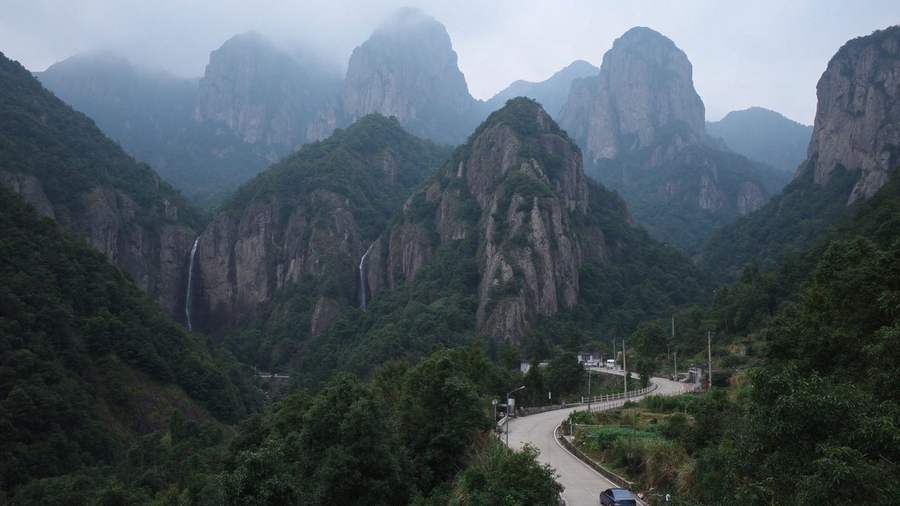
Shenxianju lies around Baita town southwest of Xianju county, a rhyolite landscape where vertical joints have sliced the mountain into stone columns; when cloud pours up from the valley, the South Gate of Heaven terrace puts you inside the cloud layer. The gate itself is a natural arch between two towers of rock, roughly a hundred metres high, with a deep gorge beneath and cool wind funnelling through. Watch the cloud sea after sunrise, the colonnade of peaks and Guanyin Peak in the distance; on clear days dozens of columns line up at once. Ride the cableway up from the visitor centre, walk twenty minutes to the gate, then follow the cliff walkway round to the north cableway and descend, about three hours. Park at the south visitor centre, plenty of spaces and chargers by the cableway station. Many steps and suspended walkways; hug the inner side if you dislike heights, and go slowly when wet.
Danzhu Stream Valley
Danzhu township sits west of Shenxianju, where the Weijiang stream runs down from the valley between stands of slender bamboo and wingnut trees. The water is shallow and clear over rounded cobbles, good for wading in summer, and the whole valley turns yellow in autumn. There is no gate ticket; this is where locals come to barbecue and camp at weekends, with several villages strung along a dozen kilometres of stream, busiest around Xiaye village where there are simple parking strips and farm restaurants. Look for the deep pools at each bend and the bamboo on both banks, sunlight flickering through the leaves onto the water. Drive slowly along the stream and stop wherever a gravel beach appeals; no need to rush. Park on the gravel strip at Xiaye, not on the village lane. The stones are slick, so wear river shoes or grippy trainers, and watch children near the deep pools.
- Where to eat
- Lunch at a Danzhu farm restaurant: small stream grouper fried in rapeseed oil with perilla, plus free-range chicken. In the county town try the Xianju eight-bowl spread, especially paoxiang and pounded pork.
- Roads and driving
- Take the Zhu-Yong expressway from Linhai to the Shenxianju exit, then a dozen kilometres of winding hill road, well surfaced but full of bends; heed the rockfall signs on the hillside. This is the mountain stretch most rental car for foreigners in China drivers cover in eastern Zhejiang.
- Where to stay
- Stay in a streamside guesthouse in Danzhu for quiet nights and running water; for more comfort return to a chain hotel in Xianju county.
Tips for the day
- Cableway queues grow after 4 pm, so climb in the morning
- Mobile signal dies in the valley floor; download offline maps first
- Umbrellas are banned on the cliff walkway; a rain jacket is more useful
Day 3 Batan old town, back to Taizhou
About 150 km, provincial road plus expressway
Batan Old Town
Batan sits on the Yong'an river about twenty kilometres west of Xianju county, a river port where salt and mountain goods were transshipped; in Ming and Qing times money houses, herbalists, pawnshops and brothels lined the street, and what remains is a five-li cobbled lane polished shiny by centuries of feet. It has not been heavily restored, the houses are still lived in, chillies and beans dry on the doorsteps and chickens wander the alleys. Look for the pebble patterns underfoot and the He family hall with its needle-pricked lanterns, whose pinholes glow like small stars. Enter at the east gate, walk the main street and duck into the side lanes; an hour covers it, longer if you sit by the river with tea. Park outside the east gate and walk in; the surface is all cobbles, awkward for wheels. Uneven ground, so wear thick soles and take it slowly if elderly.
Yong'an River Raft Landing
The Yong'an River runs past Xianju town, wide and unhurried between flood forest and vegetable plots. Bamboo rafts leave from a landing below Batan, drift four or five kilometres downstream and are towed back, about forty minutes. The rafts are local phoebe bamboo, poled by a boatman standing at the stern, and where it is shallow you see cobbles and fish below. The appeal is slowness: the water sits almost at eye level and the banks and hills slide past in layers, best in late light. Board around four in the afternoon to dodge the midday sun, then eat a bowl of stream-fish noodles ashore. Park on the open ground by the landing, free; do not drive onto the gravel bars, which swallow tyres when the river rises. Wear the life vest, expect wet shoes, bag your phone, and seat children in the middle.
- Where to eat
- Lunch in Batan: Xianju wheat cakes, thick dough folded around pickled greens and minced pork, plus stream-fish noodles. Later, hand-pulled noodles by the raft landing, and a seafood stall back in Taizhou.
- Roads and driving
- Forty kilometres of provincial road from Danzhu to Batan, smooth but with speed bumps at every village mouth; from Batan back to Taizhou take the Zhu-Yong then Yong-Tai-Wen expressway, about 110 km, busier towards evening.
- Where to stay
- No overnight needed if you return the car today; to stay another night, a riverside hotel in Jiaojiang, Taizhou, works well for river views and late-night food.
Tips for the day
- Book the bamboo raft a day ahead; walk-ins often miss out
- No cash machines in the old town; pay by QR code
- Fill the tank before returning the car; airport stations queue at night
Pages that help on this route
- Rental packages and what is included
- Temporary driving permit in China
- All routes by province
- All cars in the fleet
Costs to expect
Included: the vehicle, basic insurance, help with pick-up and drop-off paperwork, parking guidance at the sights and a trilingual road book. Not included: attraction tickets, meals and hotels, fuel and tolls, cable cars and shuttle buses inside the parks. Charges for a rental car for foreigners in China are calculated per day and confirmed on the handover sheet. Supply for a rental car for foreigners in China differs between high and low season; confirming the car a day ahead is safer.
Driving tips
- Enter Shenxianju before 8 am to avoid tour groups and full car parks
- The Linhai wall has many steps; wear grippy shoes, the stone is slippery when wet
- Mountain mornings are cold, carry a light jacket even in autumn